
Prime and Zoom Lenses Compared: Pick the Right Lens Type
The zoom lens may seem like the easier first choice, but a prime lens can teach you to frame a photograph with more intention. For beginners comparing a prime lens vs zoom lens, the key difference is simple: a prime has one fixed focal length, while a zoom lets you choose from a range without changing lenses.
It’s natural to wonder which lens is more versatile. A zoom is convenient when you can’t move freely or want to try different views of a scene. A prime asks you to move your feet, which can make composition more deliberate. Neither is automatically right for every photographer or situation.
This guide compares how prime and zoom lenses differ in focal length, size, weight, portability and everyday use. You’ll learn what each makes easier, where each involves a trade-off, and how to choose a sensible starting point for the photographs you want to take.
Key Takeaways
- Choose a prime when you want one consistent view and a chance to practise framing by moving around your subject.
- Consider a zoom when scenes change quickly or you can’t move freely, since it lets you adjust your view without changing lenses.
- Compare focal-length options before choosing: a prime keeps one focal length, while a zoom covers a range.
- Think about what you’re willing to carry; a compact setup can make everyday photography easier, while a zoom can reduce the need to pack multiple lenses.
- Use your usual subjects, shooting conditions and preferred way of working to decide which trade-off suits you best.
So… why use a prime lens?
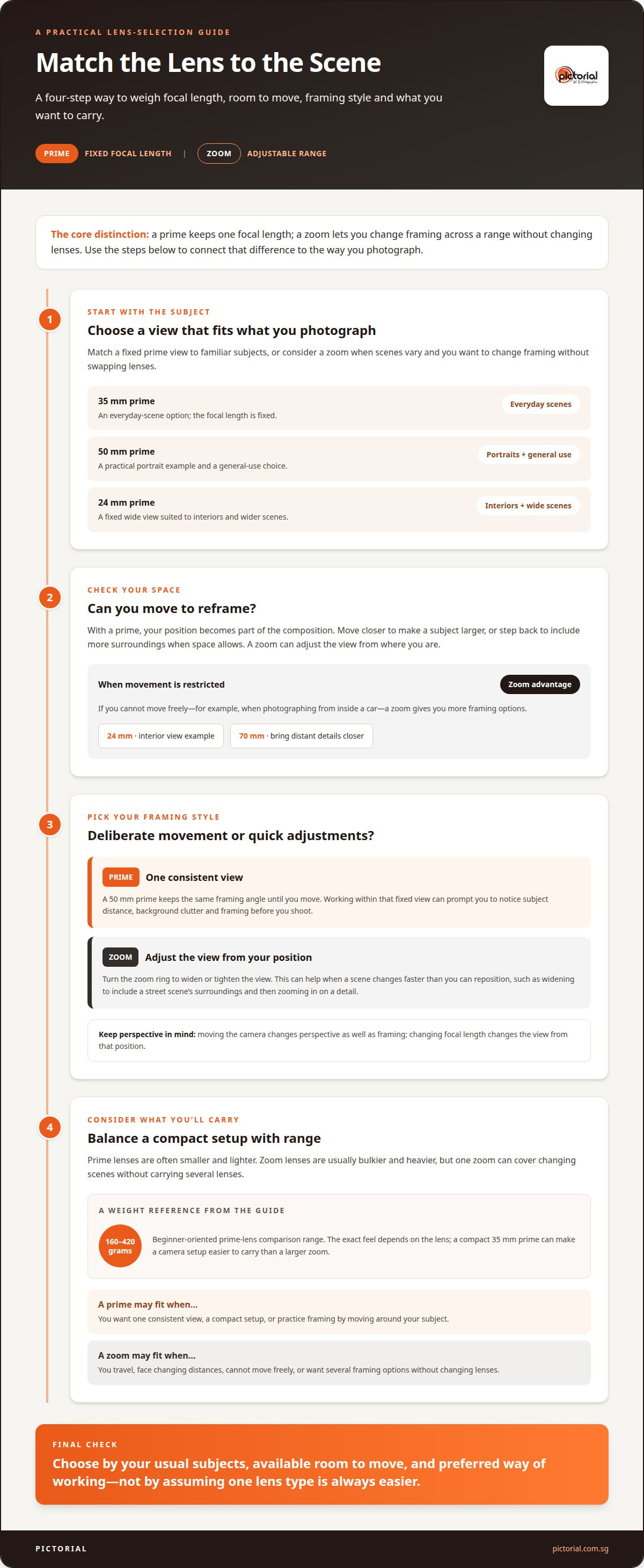
A prime lens gives you one view to work with, so your position becomes part of the composition. For example, a 50 mm prime keeps the same framing angle until you move closer to or farther from your subject. That constraint can help you notice background clutter, subject distance and framing before you press the shutter. The prime lens vs zoom lens for beginners decision often comes down to whether you enjoy that deliberate way of working.
For beginners, a zoom is often easier when the subject’s distance changes: turn the zoom ring to widen or tighten the view. A prime keeps the controls simple, but you’ll need to move to reframe. Choose the lens that suits the subject and setting rather than assuming one type is always easier to use.
For portraits, a 50 mm prime is a practical starting example; for everyday photography, 35 mm or 50 mm primes are commonly recommended as versatile choices. Travel often favours a zoom because one lens can cover changing scenes without carrying several. If you cannot move freely, such as photographing from inside a car, a zoom gives you more framing options; 24 mm can suit an interior view, while 70 mm can bring distant details closer.
An ultra-wide prime can suit architecture, interiors or broad landscapes when you want a wide view without zooming. A 24 mm prime is one standard focal-length example; 15 mm, 18 mm and 21 mm are wider examples. A wider view includes more of the scene, so check the frame edges for distractions before shooting. In a narrow Singapore walkway, that wider framing can also help include nearby buildings without stepping back.
| Option | Focal-length choice | Useful for | Main trade-off |
|---|---|---|---|
| 35 mm prime | Fixed | Everyday scenes | Move to change framing |
| 50 mm prime | Fixed | Portraits and general use | One angle of view |
| 24 mm prime | Fixed | Interiors and wider scenes | Cannot tighten the view |
| Zoom lens | Range varies | Travel and changing distances | More range to manage |
For a prime lens vs zoom lens for beginners comparison, start by listing the subjects you photograph most and matching a lens’s view to those scenes. If you want to practise careful framing, try a prime. If you want to adapt quickly while travelling, a zoom may suit you better. Guided shooting can also help beginners practise focal length, aperture and composition.
One prime lens can be a sensible first choice if its fixed view suits your routine. A zoom is more adaptable when you want to explore different compositions without changing lenses. Decide based on the scenes you photograph, how much room you have to move, and how you prefer to work.
Fixed focal lengths and how prime lenses work
A prime lens has one focal length; a zoom lens covers a range. This affects how you frame a scene and adapt when your subject or position changes.
Fixed Focal Lengths
A prime lens has a fixed focal length and angle of view. A 50 mm lens is one example, while 24 mm and 50 mm are standard prime focal lengths. To make the subject larger in the frame, move closer; to include more surroundings, step back if space allows. Unlike a zoom, the lens itself cannot change its framing range.
That fixed view can make choosing a prime straightforward: decide which perspective suits the scenes you photograph, then learn to work within it. Prime lenses also come in longer focal lengths. Examples include 300mm, 400mm, 500mm and 600mm options for telephoto and super-telephoto photography. These are distinct choices, not settings you switch between on one prime lens.
Focal Length and Field of View
Focal length, measured in millimetres, affects how much of a scene fits in the frame. A shorter focal length gives a wider view; a longer one gives a narrower view and frames distant subjects more tightly. The camera’s sensor also affects the field of view, so the same focal length can frame differently on different camera formats.
For a practical comparison, photograph the same scene at different focal lengths and notice which edges enter or leave the frame. Keep your position fixed. Moving the camera changes perspective as well as framing, while changing focal length alters the view from that position.
A zoom lens offers a continuous range of focal lengths. A 16-35mm zoom, for example, lets you adjust framing across its range without swapping lenses. An 18-300mm superzoom covers a much broader span, making it possible to move from wide views to distant details with one lens. A prime gives you one focal length instead.
A zoom is useful when the scene changes faster than you can reposition. In a street scene, you can widen the frame to include the surroundings, then zoom in on a detail. With a prime, you’ll need to move or accept a different composition. Neither lens changes the subject’s actual distance; only your position does.
Choose a focal length by matching the frame you want to the space available. A shorter focal length may suit a wide landscape; a longer one may work better for a distant subject. When comparing a prime and a zoom, decide first whether you value a consistent view or the ability to adjust framing from one spot. That makes the practical difference clear.
Lens size, weight, and portability
A lens affects more than framing: it also changes how comfortable your camera feels during a walk or shoot. Prime lenses are often smaller and lighter, while zoom lenses are usually bulkier and heavier.
Lens Size and Weight
A beginner-oriented comparison gives prime lenses a weight range of 160 to 420 grams. The exact feel depends on the lens, but this range gives you a practical reference when comparing options. A compact 35 mm prime, for example, can make a lighter camera setup easier to carry than a larger zoom.
Zoom lenses often cover several focal lengths in one barrel, which can make them larger. That extra size may affect how the camera sits in your hand or fits in a small bag. Compare the whole setup, not just the lens: mount each option, hold the camera as you normally would, and notice its balance.
Length and shape matter, too. A longer lens can shift the camera’s balance forward, while a shorter prime may feel more compact against your body. Try holding the camera at eye level and at waist height. If either position feels tiring during a short practice session, the setup may be less comfortable on a longer outing.
Lens Portability
Portability depends on how you photograph, not just the weight printed on a lens. A prime gives you one focal length in a smaller, lighter package; a zoom can replace the need to carry several lenses. For travel, that might mean packing one zoom instead of separate wide and telephoto primes.
Picture a day walking through busy streets. A compact prime can be easy to carry between stops, while a zoom lets you change framing without changing lenses. If you carry a camera all day, the lighter option may feel more comfortable; if flexibility matters more, one zoom may simplify what you pack.
Use this quick comparison before choosing:
- Prime: prioritise a small, light setup and one familiar view.
- Zoom: prioritise several framing options from one lens.
- Either: check the camera’s balance and how the lens fits your bag.
Background and shooting position also influence what feels practical. A 35 mm prime may work well when you can move around a subject, but a tight space can limit your position. A zoom gives you more framing choices from where you stand. For an everyday camera, weigh the lens you’ll carry against the range you’ll actually use.
Before deciding, picture a real outing, such as a camera walk through a park. Consider how long you’ll carry the camera, whether you can change position, and whether swapping lenses would interrupt the moment. These details help you weigh a lighter prime against a more adaptable zoom setup.
How zoom and prime lenses differ
A prime offers one focal length; a zoom covers a range. This affects how quickly you can adjust the frame and what you carry on a shoot.
Image Quality and Sharpness
Prime lenses have traditionally offered stronger image quality, but zoom lenses have been catching up. A lens’s sharpness depends on its optical design, focal length and aperture, so the lens type alone doesn’t decide the result. For example, a 50 mm prime with a maximum aperture of f/1.8 can gather more light than an 18-55 mm zoom set to f/5.6 at its long end.
Sharpness also depends on focus and technique. If a portrait subject’s eyes are slightly out of focus, a sharp lens won’t restore that important detail. Compare photographs made with the same camera, subject and focus point. Look closely at the eyes and fine edges rather than judging by the lens label alone.
Zoom Lens Advantages and Disadvantages
For beginners, zoom lenses make it easier to change framing without moving or swapping lenses. An 18-55 mm zoom can move from wide-angle to normal and telephoto views, letting you photograph a landscape and then frame a tighter detail. This range encourages exploration, especially when a subject moves or your shooting position is limited.
The trade-off is that zooms are usually heavier and bulkier than primes, and can have smaller maximum apertures. An 18-55 mm example has a maximum aperture range of f/3.5-5.6, while a 50 mm prime example reaches f/1.8. A wider aperture can help in dim light and create a shallower depth of field, but it doesn’t guarantee a sharper photograph.
Zoom lenses offer flexibility and convenience, but can be larger, heavier and have a narrower maximum aperture. A prime’s fixed framing can encourage deliberate composition, but you’ll need to move to change the view. Choose according to the subject and setting: a zoom helps when the distance changes quickly, while a prime suits a consistent shooting style.
Try a simple comparison using one scene. Keep your camera position steady, frame the subject with a zoom, then use a prime at a similar focal length. Notice how quickly you can compose with each setup, and inspect the subject’s detail at the same viewing size. This helps distinguish optical characteristics from changes caused by distance or framing.
For a beginner, neither type automatically produces better photographs. A prime may offer a wider maximum aperture and a lighter setup; a zoom can help you respond to changing scenes without switching lenses. The choice comes down to whether you value aperture and a fixed view or framing flexibility in everyday photography.
Prime and zoom lens definitions
A prime lens has one fixed focal length, while a zoom lens covers a continuous range. The distinction is about how the lens changes framing, not whether the camera can focus or whether the photograph will be sharp.
Look at the numbers printed on a lens barrel to identify its type. A single focal-length number, such as 50 mm, indicates a prime. Two numbers joined by a dash, such as 16-35mm, show the zoom’s available range. A superzoom example, 18-300mm, covers a much broader range in one lens.
The markings describe focal length, not the lens’s physical length. Depending on its design, a zoom changes focal length internally or by extending its barrel. A prime keeps the same focal length, even when you focus on subjects at different distances. Focusing changes what appears sharp; it doesn’t turn a prime into a zoom.
The sensor in your camera also matters when you interpret a focal-length number. The lens retains its stated focal length, but different sensor sizes can record different portions of the lens’s view. This is why a 50 mm lens may frame differently on two camera formats. Compare lenses on the camera you actually use, rather than relying on the number alone.
Aperture markings are separate from focal-length markings. For example, a 50 mm prime with a maximum aperture of f/1.8 combines one fixed view with a wide aperture. A zoom may show an aperture range, such as f/3.5-5.6, because its maximum aperture changes across the zoom range. Read both sets of markings: one tells you the view, and the other describes light-gathering capacity.
Prime lenses are available in more than one role. A 24 mm prime is a standard focal-length example, while 300mm, 400mm, 500mm and 600mm primes are telephoto or super-telephoto options. Each gives a fixed view suited to a different framing need. Zoom lenses trade that single choice for adjustable framing, as with 16-35mm or 18-300mm ranges.
In practice, these definitions make the choice easier to understand. When a scene changes and you need to reframe quickly, a zoom lets you adjust its optical range without changing lenses. If one view suits your subject and working distance, a prime keeps your framing consistent. Sharpness depends on several factors, so neither lens type guarantees a sharper image.
The key point is simple: a prime has one focal length, while a zoom covers a range. Match that difference to the situations you photograph, then practise using your lens deliberately.
Pictorial
Pictorial helps beginners turn lens choices into practical decisions through hands-on photography courses. In outdoor sessions, you can use your own camera or borrow one at no charge, then practise framing and focal length in real scenes. This is useful if you understand the difference between a prime and a zoom but aren’t sure which suits your photography.
A Photography Starter Session or Basic Photography Course can help you build core camera skills and explore different lens styles. If you already have experience, an Intermediate Photography Course offers a next step for developing your technique. Choose a starting point based on the skills you want to practise.
Contact Pictorial through the registration page to discuss your photography learning.
Make your next photo a learning step
Your next lens decision can start with observation, not a purchase. On your next photo walk, notice when you wish you could change the framing and when moving feels natural. Those moments reveal more about your habits than a specification sheet can.
That’s a practical way to approach the prime lens vs zoom lens choice for beginners: let the photographs you want to make guide your practice. If you’re learning with a phone, Pictorial’s Mobile Photography Essentials can help you develop your eye and composition skills before choosing camera equipment.
A lens is a tool, not a test of whether you belong in photography. Keep making pictures, notice what feels limiting, and let your experience guide your next choice.
Frequently Asked Questions
But What About f/2 and f/1.8 Zooms?
A zoom labelled f/2 or f/1.8 is still a zoom: its focal length changes, while the number describes its maximum aperture. The label alone doesn’t show whether that aperture remains available throughout the zoom range. In a dim indoor scene, a wide maximum aperture can help you use a faster shutter speed. Focus accuracy and subject movement still affect the result, so read the aperture information for the lens’s full range.
So, which one should you choose?
Choose the lens that fits the situations you photograph most. If you often photograph moving subjects or can’t easily change position, a zoom offers more framing choices. If you prefer a consistent view and want to practise composing within it, a prime may suit you. Before deciding, consider your usual subjects, shooting spaces and whether flexibility matters more than a compact setup.
What is a zoom lens?
A zoom lens lets you adjust its focal length within a defined range, such as 18-55 mm. Turn its zoom ring to make a subject appear larger or smaller in the frame without changing lenses. This is useful at a family gathering, where you might frame a group and then capture one person. Your camera position stays the same, so the perspective doesn’t change as it would if you moved closer.
What is the difference between a prime lens and a zoom lens?
A prime lens has one focal length, while a zoom lens covers a range. For example, a 50 mm prime stays at 50 mm; an 18-55 mm zoom can be adjusted between its endpoints. That difference affects how you respond to a scene. With a prime, you change framing by moving or accepting a different composition. With a zoom, you can adjust framing from the same position.
What are the advantages and disadvantages of prime lenses for beginners?
A prime lens can offer a simple, consistent view and a wide maximum aperture, which may help in dim settings. Its fixed framing also gives you a chance to practise composition deliberately. The trade-off is that you can’t zoom in or out; a wall, crowd or barrier may prevent you from moving to reframe. A prime suits beginners who are comfortable working with one view during a shoot.
What focal length should a beginner choose for a prime lens?
A 35 mm or 50 mm prime can be a useful starting point because each suits a range of everyday subjects. Choose 35 mm if you often want more of the surroundings in your frame. Choose 50 mm if you prefer a tighter view for portraits or details. The camera’s sensor affects the view you get, so consider how each focal length frames scenes on your camera.
What zoom lens range is best for beginner photography?
An 18-55 mm zoom is a practical range to learn with because it covers wide-angle, normal and telephoto views. You can use the wider end for a group or landscape, then adjust toward the longer end for a tighter frame. If you photograph mostly distant subjects, a longer-reaching range may fit better. Let your usual subjects guide the choice rather than choosing the widest range by default.
How do prime and zoom lenses compare in low-light performance and aperture?
Low-light performance depends partly on maximum aperture. A lens with a wider aperture lets more light reach the sensor, which can help you use a faster shutter speed indoors or at dusk. Some primes offer wide maximum apertures, while zoom lenses vary by design. A faster shutter can reduce blur from movement, but won’t freeze a moving subject if it’s still too slow.

Disclaimer
© Pictorial | All Rights Reserved.