
Types of Camera Lenses for Beginners: Find Your First Lens
The biggest zoom range isn’t always the easiest first choice. The types of camera lenses for beginners are easier to understand when you start with two basics: a prime lens has one fixed focal length, while a zoom lens covers a range. Once you know how focal length changes your angle of view, you can choose a lens that suits what you want to photograph.
It’s reasonable to feel unsure when lens names, numbers and camera compatibility all seem to matter at once. This guide explains prime and zoom lenses, then shows how wide-angle, standard and telephoto lenses frame a scene differently. You’ll also learn how sensor size affects the view, what to consider when choosing a first lens for a Canon camera, and why a familiar 50mm prime can be a useful way to practise. The goal isn’t to find one lens for every situation. It’s to understand the choices well enough to make a calm, practical decision.
Key Takeaways
- A prime lens gives you one fixed focal length, while a zoom lets you change focal length without changing lenses.
- Focal length shapes your angle of view: wider lenses include more of a scene, while telephoto lenses frame distant subjects more tightly.
- Match a lens to your camera’s sensor format and mount so it fits and works as intended.
- Your Canon camera’s kit lens can help you explore different focal lengths before choosing a more specialised lens.
- Use the kind of photos you enjoy taking to narrow your choice, then build practical confidence by learning how lenses affect a scene.
What types of camera lenses are there?
Lenses differ by focal range, purpose and mount, so the right choice depends on the camera body and the photographs you want to make. Sensor size also affects how wide or tight a lens appears in a particular situation.
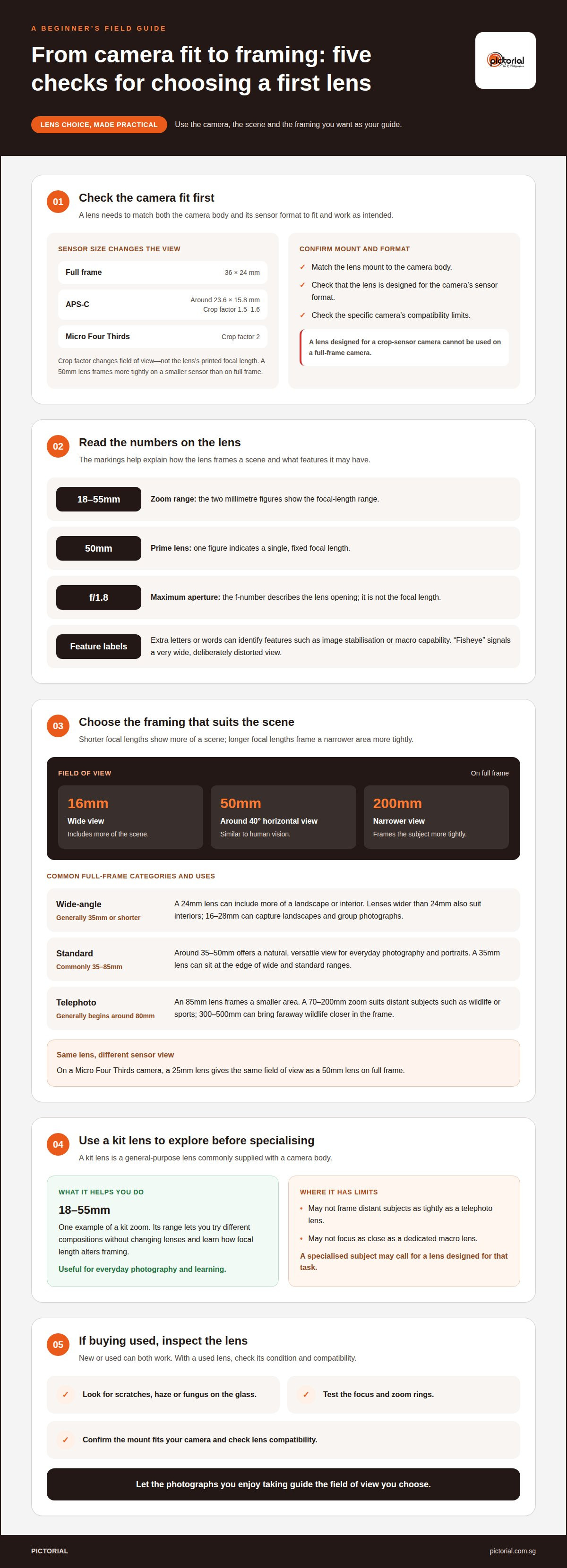
A full-frame sensor measures 36 × 24 mm, while an APS-C sensor measures around 23.6 × 15.8 mm. APS-C cameras have a crop factor of 1.5-1.6, depending on the camera; Micro Four Thirds cameras have a crop factor of 2. The crop factor changes the field of view, not the lens’s printed focal length. A 50mm lens therefore frames more tightly on a smaller sensor than on full frame.
Camera type matters too. DSLR and mirrorless bodies use different lens mounts, and even cameras from the same manufacturer may have separate mounts or compatibility limits. Match the lens mount to the camera body, then check whether the lens is designed for that sensor format. A lens designed for a crop-sensor camera cannot be used on a full-frame camera. Lens compatibility can vary between camera bodies, so check compatibility before choosing a lens.
Lens names provide useful clues. The millimetre figure, such as 18-55mm, gives a zoom lens’s focal-length range; a single figure, such as 50mm, indicates a fixed focal length. The f-number describes the maximum aperture, and additional letters or words can identify features such as image stabilisation or macro capability. A fisheye lens signals a very wide, deliberately distorted view rather than a standard perspective.
Matching Lenses to Subjects and Uses
Choosing a lens means matching its field of view and focusing ability to your subject and shooting style. A wide view can include a landscape or group, while a longer focal length frames a distant subject more tightly. For close-up details, a macro lens is designed to focus at short distances.
Think about where you’ll stand and how much of the scene you want in the frame. A lens for indoor family photographs may need to show more of a room than one used to isolate a distant bird. This practical difference can narrow your options before brand names do.
Kit Lens Strengths and Limits
A kit lens is a general-purpose lens commonly supplied with a camera body; 18-55mm is one example. Its zoom range lets beginners try different compositions without changing lenses, making it useful for everyday photography and learning how focal length alters framing.
A lens’s range also involves trade-offs. A kit zoom may not frame distant subjects as tightly as a telephoto lens or focus as close as a dedicated macro lens. It gives you room to explore, but a specialised subject may call for a lens designed for that task.
Should beginners buy a new or used camera lens, and what should they check? Either can work; with a used lens, inspect the glass for scratches, haze or fungus, test the focus and zoom rings, and confirm the mount fits your camera. A new lens has no previous use, but condition and compatibility matter most when buying used.
For beginners who want to connect lens choices with camera controls and practical photography, a basic photography course for beginners can help build those foundations.
Focal length and angle of view
Focal length, measured in millimetres, describes how much of a scene fits into a photograph. A shorter focal length shows a wider view; a longer one frames a narrower area.
On a full-frame camera, a 50mm lens has a horizontal field of view of around 40 degrees, similar to human vision. A 16mm lens gives a wide angle of view, while a 200mm lens narrows the view and magnifies the subject. These examples show why focal length affects composition, not just apparent distance.
Wide, Standard, and Telephoto Focal Lengths
Wide, standard and telephoto describe broad focal-length categories, each with a different angle of view. On full frame, wide-angle lenses are generally 35mm or shorter, standard lenses commonly span 35mm to 85mm, and telephoto lenses generally begin around 80mm.
These categories help you anticipate how a scene will fit before lifting the camera. A 24mm lens can include more of a landscape or interior, while an 85mm lens frames a smaller area. A 300mm lens belongs to the super-telephoto range and can bring distant wildlife closer in the frame.
Labels can overlap because lens categories are useful guides, not a single universal boundary. A 35mm lens sits at the edge of common wide and standard ranges, so consider the composition it gives you rather than relying on its category alone. The camera’s sensor also affects the resulting field of view.
Focal Lengths for Common Subjects
Focal lengths for common subjects are starting points for choosing a field of view, not rules you must follow. Around 35-50mm gives a natural, versatile view for everyday photography and portraits, while 50mm or 85mm primes are common portrait options.
For landscapes and group photographs, 16-28mm captures a broad scene; lenses wider than 24mm also suit interiors. A 70-200mm zoom offers a narrower view for distant subjects, including wildlife or sports. For birds and other wildlife, an ultra-telephoto lens between 300mm and 500mm brings faraway subjects closer without requiring you to move nearer.
On a Micro Four Thirds camera, a 25mm lens gives the same field of view as a 50mm lens on full frame. That difference matters when comparing lenses across camera systems. Focal length also isn’t aperture: an f-number such as f/1.8 describes the lens opening, while millimetres describe its angle of view.
Think about the scene you want to include, then compare the focal lengths that frame it. A zoom such as 28-200mm lets you adjust between a wider and tighter view, while a 50mm prime keeps one fixed perspective. Matching that choice to your subject makes the numbers useful in practice.
What is a prime lens?
A prime lens has one fixed focal length, while a zoom lens covers an adjustable range. With a prime, you move closer or farther to change the framing; with a zoom, you turn the lens barrel.
For example, a 50mm prime stays at 50mm, while an 18-270mm zoom can move across a much broader range. Prime lenses ask you to work with one view, which can help you notice composition and subject distance. Zoom lenses make it easier to reframe quickly when your position or subject changes.
Neither type is automatically better for every situation. A prime can offer a large maximum aperture, while a zoom can cover several framing needs without changing lenses. For a beginner, consider whether you value a consistent view or more framing flexibility in one lens.
Prime Lenses for Portraits and Low Light
Prime lenses for portraits and low light combine a fixed view with the option of a large aperture on some models. An f/1.4 aperture lets in more light than f/4, which can help when photographing indoors or in dim conditions.
A larger aperture such as f/1.8 can also create a shallow depth of field, making the subject stand out against a softer background. That effect depends on focus and distance as well as the aperture setting, so precise focus matters when photographing a face. Some primes offer f/2.8 apertures, another useful option for low-light photography.
The trade-off is that a fixed focal length won’t let you zoom in or out. If a portrait subject moves, you’ll need to adjust your position or include more space in the frame. Telephoto lenses can also be primes, so “prime” describes a fixed focal length, not whether a lens is wide or telephoto.
The 50mm Prime for Portraits
A 50mm prime gives portrait photographers one steady angle of view and a familiar working distance. It’s a common portrait option, while an 85mm prime is another choice when you want a tighter frame.
A 50mm f/1.8 prime combines that fixed focal length with a larger maximum aperture than f/4. The aperture can help in low light and soften the background, but it doesn’t change the lens’s focal length. Focus carefully on the subject’s eyes, since a shallow depth of field can leave other facial details softer.
Use the 50mm view to practise making small changes in your position and composition. If the frame feels too tight for a group portrait, step back; if the subject feels small, move closer. That simple adjustment shows how a prime lens makes camera position part of the photograph.
Choose a prime when its fixed view suits the subjects you photograph most, or when a larger aperture matters to your work. Choose a zoom when changing the framing quickly is more useful than sticking to one focal length. These are practical differences, not a test of which lens makes someone a better photographer.
Standard, wide-angle and telephoto lenses
These categories describe how a camera lens frames a scene, from broad landscapes to distant wildlife. Their focal-length ranges help you anticipate the field of view on compatible camera bodies.
Standard and Wide-Angle Lenses
Standard lenses give a familiar perspective, while wide-angle lenses include more of the scene. On full frame, standard lenses are commonly associated with 35mm to 85mm; wide-angle lenses generally reach 35mm or less.
A 24mm lens can capture more of a landscape or interior than a 50mm lens from the same position. That wider field of view helps when you can’t step back, such as photographing a group in a small room. It can also make nearby objects appear prominent, so placement matters. Choose a wide angle for scene-setting, not simply because more fits.
Telephoto Lenses for Distant Subjects
A telephoto lens narrows the field of view and frames distant subjects more tightly. Full-frame telephoto lenses generally begin around 80mm, while a 70-200mm zoom gives room to adjust framing across its range.
A longer focal length can help when you can’t move closer, such as when photographing a performer across a stage or details high on a building. It doesn’t bring you physically nearer; it enlarges a smaller part of the scene within the frame. The tighter view also makes precise framing more demanding, so steady camera handling matters.
Telephoto Lenses for Wildlife and Sports
Telephoto lenses suit wildlife and sports because they frame action from a distance. A 70-200mm zoom can cover changing compositions, while an ultra-telephoto focal length between 300mm and 500mm is recommended for birds and other wildlife.
At a field or nature reserve, that reach helps fill the frame without approaching the subject. A zoom lens also lets you widen the composition when an animal moves closer or an athlete crosses the frame. For a beginner, consider both the subject’s distance and how quickly it moves. A long focal length alone won’t ensure sharp action photographs.
Telephoto and Ultra-Telephoto Lenses
Telephoto lenses cover a range of longer focal lengths, while ultra-telephoto lenses begin at 300mm. This distinction helps you judge whether a lens suits nearby sports action or subjects far across an open landscape.
For example, a 200mm lens offers a narrower view than a standard lens, but it falls below the ultra-telephoto threshold. A 300mm lens or longer can frame distant birds more tightly. Longer lenses can also be larger and heavier; a 600mm prime is one example. Consider how you’ll carry and support the camera, not only how far the lens reaches.
For landscapes, a 16-28mm lens gives a broad view; for distant wildlife, 300-500mm offers much tighter framing. These are practical starting points, not fixed rules. Your subject’s distance, movement and surroundings all affect which focal length helps you compose the photograph.
Beginner lenses for Canon cameras
For a Canon beginner, the most useful first lens depends on the camera mount and the subjects you want to photograph. A kit zoom offers flexibility, while a wide-angle or large-aperture lens suits a more specific need.
Start with the lens already supplied with your camera, if it has one. An 18-55mm zoom covers a useful range for everyday scenes, from wider views to tighter framing. Its maximum aperture changes across the zoom range: an 18-55mm f/3.5-5.6 lens reaches f/3.5 around 18mm and f/5.6 at 55mm. That affects how much light enters as you zoom, which can matter indoors or when you want a faster shutter speed.
For a versatile upgrade on compatible Canon mirrorless cameras, the RF-S 18-150mm f/3.5-6.3 IS STM spans a broad focal range. It can frame a landscape at the wider end, then tighten the view for portraits or distant details. Its maximum aperture also changes across the range, so it doesn’t gather the same amount of light at every focal length.
If landscapes, architecture or group photographs are your main subjects, consider the Canon RF-S 10-18mm f/4.5-6.3 IS STM. Its wide-angle view includes more of a scene, which can help in a confined space. It’s more specialised than an everyday zoom, so it may not be the first choice if you want one lens for varied subjects.
Match the lens to your camera body before choosing between those examples. Canon lens names include a mount or format clue, such as RF-S, alongside focal length and aperture figures. Use the camera’s compatibility information to identify the right mount. A lens that doesn’t fit the body won’t suit your photography, however appropriate its focal length may seem.
How much do beginner camera lenses cost in Singapore? Prices vary with the lens mount, focal range, maximum aperture, stabilisation features, and whether the lens is new or used. A broad zoom and a specialised wide-angle lens serve different purposes, so compare their features with the situations you photograph rather than relying on focal length alone.
A practical starting point is to use a kit zoom for different kinds of photographs, then notice where its framing or aperture limits you. If you often want a wider view, a Canon wide-angle lens may fit; if you need more reach, a versatile zoom may suit better. Tie your next choice to a real need, not just a longer specification list.
Practise photography fundamentals
Pictorial
Pictorial’s hands-on photography courses help you connect lens choices with practical camera skills, so focal length and framing make sense while you shoot. Bring your own camera or borrow one at no charge, and practise outdoors with personalised guidance in a group strictly limited to three participants. There is no minimum starting requirement for group classes.
If you’re just starting, a Basic Photography Course can help you practise foundational camera skills. The Photography Starter Session offers another starting point, while the Complete Photography Course suits learners seeking broader instruction. These courses focus on learning photography, not buying equipment, so they’re useful when you want guidance applying lens concepts to real scenes.
If you’d like support choosing and using a beginner lens, contact Pictorial to discuss your photography learning goals.
Build confidence with the camera you have
Your first lens doesn’t need to settle every photography question. Use it to practise noticing how your position, framing and subject change the photograph. As you shoot, pay attention to when you want a wider view, more reach or a brighter aperture. Those observations can guide your next choice more clearly than a long list of specifications.
The types of camera lenses for beginners become easier to choose when you connect each option to the pictures you want to make. For guided practice, Pictorial’s Intermediate Photography Course builds on existing skills, while Mobile Photography Essentials focuses on taking photographs with a phone. Choose the course that suits how you want to keep learning and make more deliberate images.
Take your time, keep making photographs, and let your own experience shape what comes next.
Frequently Asked Questions
What is a zoom lens?
A zoom lens lets you change framing by adjusting its focal length, rather than changing lenses. For example, a 28-200mm zoom can move from a broad view to a much tighter one. This range can be handy during travel or family gatherings, where subjects and shooting positions change quickly. Turn the zoom ring, then recompose; remember that zooming changes the view, not your physical distance from the subject.
What does the lens on a camera do?
A camera lens gathers and focuses light to form an image on the camera’s sensor. Focusing directs light from the subject into a sharp image, while the aperture controls the opening through which light passes. For example, when photographing a person near a bright window, focus sets the face’s sharpness and aperture affects exposure and background blur. The lens also determines the view captured, so changing lenses changes how the scene is framed.
Which lens is right for a beginner photographer?
The right beginner lens fits your camera and suits the subjects you photograph most. If you’re exploring different compositions, a kit zoom gives you room to experiment without swapping lenses. For portraits, a fixed focal-length lens can help you practise framing through movement. Before choosing, identify your camera’s mount and sensor format, then consider whether you mainly photograph people, wide scenes, close details or distant action.
And what is a fisheye lens?
A fisheye lens is an ultra-wide lens that creates a strongly curved, distorted view. Fisheye lenses commonly cover 4-14mm, and some can show a field of view of 180 degrees. That dramatic perspective can suit creative architecture, action or tightly enclosed scenes, but straight lines near the frame edges may appear curved. For a natural-looking landscape, a standard wide-angle lens usually gives a less exaggerated result.
What about those numbers on lenses?
Numbers on a lens identify its focal length and aperture. A marking such as 18-55mm describes a zoom range, while f/3.5-5.6 indicates the maximum aperture changes across that range. The first number helps you understand how widely the lens can frame; the f-number helps you judge its light-gathering opening. If a lens shows 50mm f/1.8, it has one focal length and a maximum aperture of f/1.8.
What are prime lenses?
Prime lenses have a single focal length, so you compose by moving rather than zooming. That makes them useful for practising how camera position changes the relationship between a subject and its background. For instance, a 35mm prime can suit a wider environmental portrait, while an 85mm prime frames a face more tightly. Choose a prime when its fixed view fits your usual subjects, rather than expecting one focal length to suit every scene.
What are zoom lenses?
Zoom lenses cover a range of focal lengths, making them useful when you can’t easily change position. At a family event, you might frame a group at the wider end, then tighten the composition for one person. The lens doesn’t move you closer; it changes how much of the scene appears in the frame. A broad range offers flexibility, while a narrower range may suit a more specific kind of photography.
What are the main types of camera lenses for beginners?
The main types of camera lenses for beginners include standard, wide-angle, telephoto, macro, fisheye, prime and zoom lenses. These names describe different views or uses: macro lenses focus on close details, while fisheye lenses create an unusually broad, curved perspective. Prime and zoom describe whether focal length stays fixed or adjusts. Start by matching the lens’s intended use to your subject, then make sure it fits your camera.

Disclaimer
© Pictorial | All Rights Reserved.