
Photography Class: Complete Course Guide for 2026
What if choosing a photography class felt less like a leap and more like a clear next step? If you’ve searched “enroll photography class,” you may still be wondering whether you need camera experience, how much time lessons take, and which format suits your goals. Those are sensible questions, and the course structure can help you answer them.
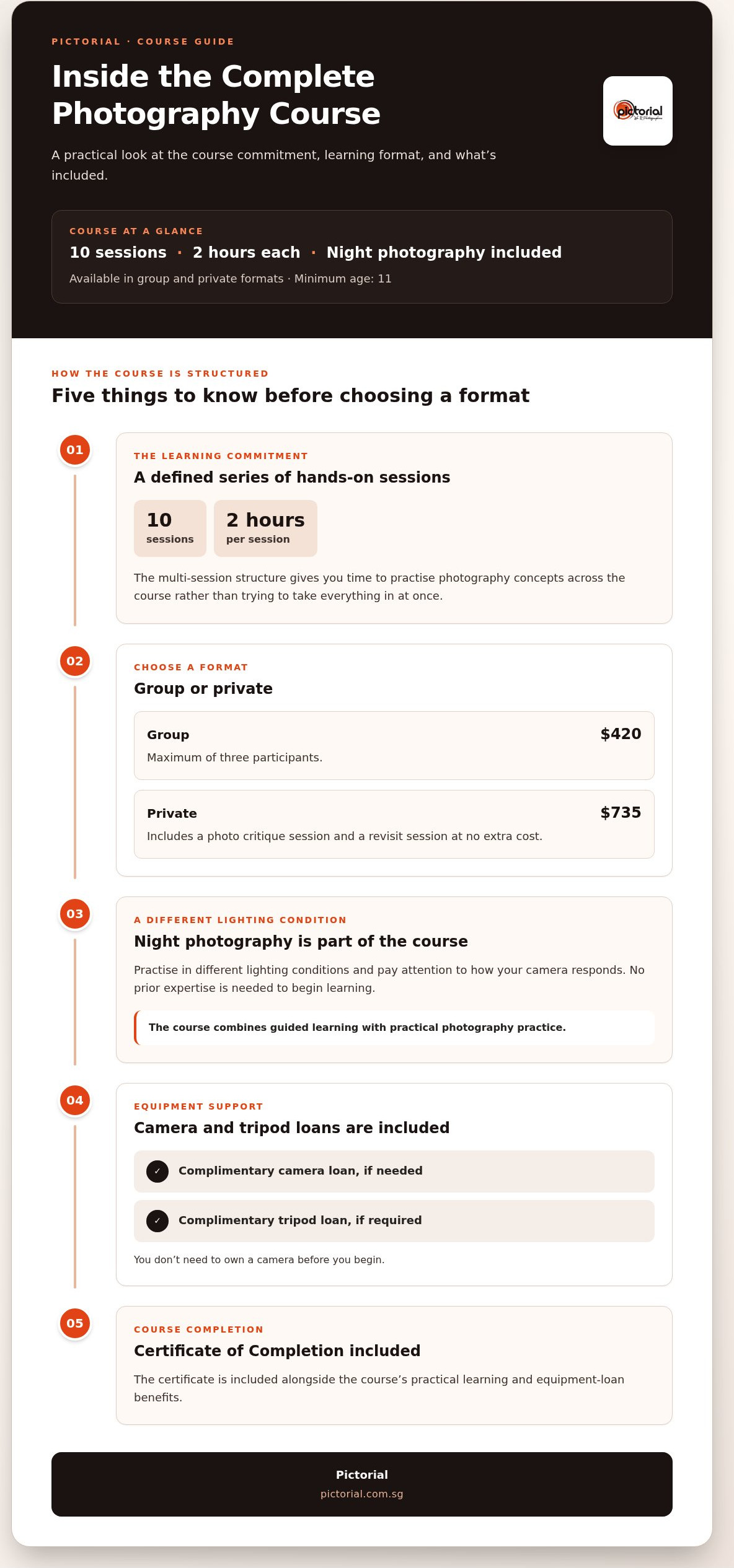
The Complete Photography Course has 10 sessions of 2 hours each and includes night photography. It is available in group and private formats, and the minimum age is 11. Group classes have a maximum of three participants. The private format includes a photo critique session and revisit session at no extra cost. Complimentary camera loan (if needed), Complimentary tripod loan (if required), and Certificate of Completion are included.
This guide covers what to expect, how the formats and time commitment compare, and what to consider before registration. Pictorial offers hands-on photography courses for beginners and advanced learners, with small classes and practical outdoor shooting. By the end, you’ll have a clearer sense of whether the Complete Photography Course fits your goals and schedule.
Key Takeaways
- Start by deciding whether you want to build photography foundations, strengthen existing skills, or follow a structured learning plan.
- Review the Complete Photography Course details, including its 10 sessions, night photography, and age minimum of 11.
- Compare group and private formats, including their fees and the private format’s photo critique and revisit sessions.
- Plan around the course commitment and schedule: group sessions run Monday-Sunday, 11 AM-1 PM or 2 PM-4 PM, with a separate night-photography time.
- If you searched “enroll photography class,” use the checklist in this guide to weigh course fit, format, age eligibility, and time before registering.
Ready to Enroll in a Photography Class? Start with Your Learning Goal
Choosing a class can feel difficult when terms such as aperture, shutter speed, and ISO are unfamiliar. You don’t need to understand every camera setting before you begin. Start by deciding what you want to do more confidently: build your foundations, develop skills you’ve already started practising, or follow a structured course with time to apply what you learn. Whether your long-term ambition is specialised professional training through the Institute of Wedding Photographers or simply mastering everyday shots, clarifying your objective makes choosing the right class much simpler.
Think about the photographs you want to make. Perhaps you’d like to capture family moments more deliberately, take stronger travel photographs, or learn to work with changing light. Naming a real situation gives you a practical goal and makes it easier to compare learning options. For an overview of photography’s background and range of approaches, explore the history and techniques of photography.
What do you want to be able to do with your camera?
Consider where you feel least sure. Do you want more control over brightness instead of relying on automatic settings? Are you hoping to photograph moving subjects, make sharper images indoors, or understand how light changes a scene? One or two everyday situations are enough to help you identify what you want to practise.
A short introduction and a longer course suit different learning preferences. The Photography Starter Session is a focused introduction, while a multi-session course gives you more opportunities to revisit skills. The Complete Photography Course has 10 sessions of 2 hours each; the Photography Starter Session has 1 session of 3 hours. If you’re comparing a short introduction with a longer commitment, explore the photography course options and consider how much structured practice you want.
Think about whether you learn best by trying a setting, seeing what changes, and trying again. In hands-on sessions, you can connect camera controls to deliberate choices as you make photographs. Rather than memorising a setting in isolation, notice how adjusting it affects the image in front of you.
When does a structured photography class make sense?
A class can help when you want more than tips to remember later. With guided practice, you can try an unfamiliar control while making a photograph, observe the result, and ask questions as they arise. Linking an adjustment to its effect can make technical ideas easier to understand and use again.
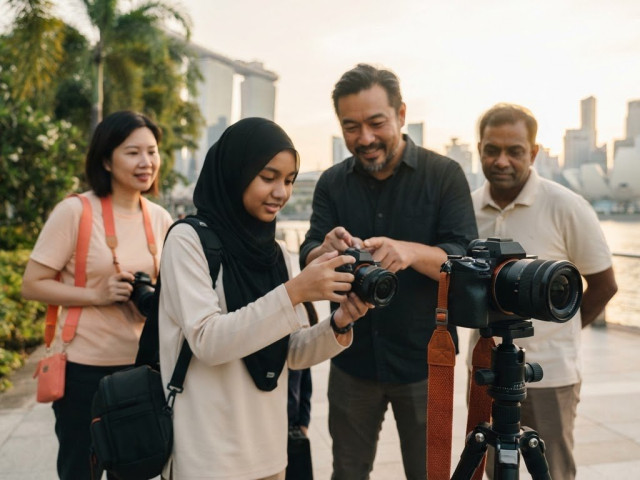
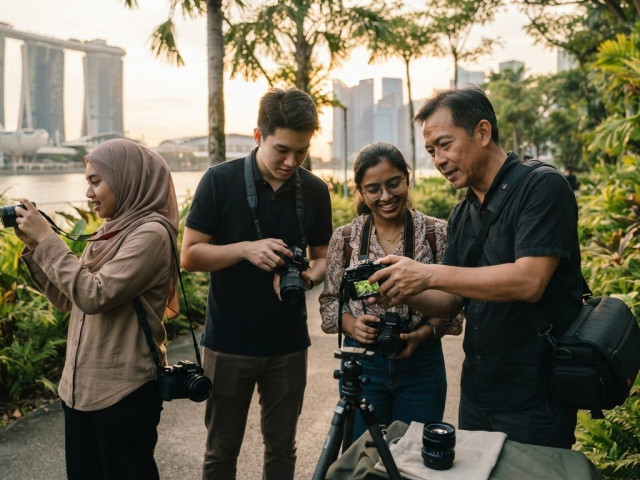
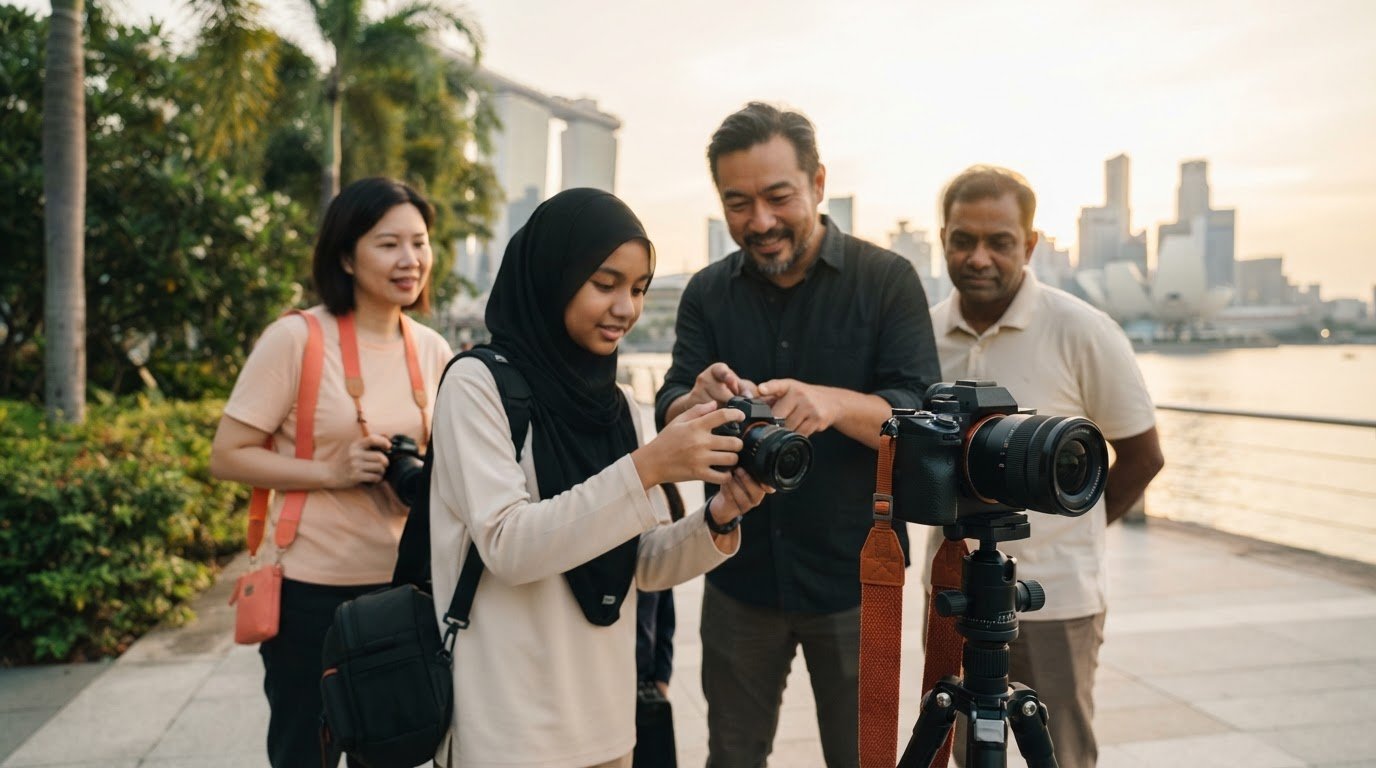
Small-group learning leaves room to work through practical questions. One learner may need help with focus, while another wants to understand how light affects exposure. Pictorial classes have a maximum of three participants, so you can practise in a small group and get guidance as questions come up.
If you’re searching for how to enroll photography class, let your learning goal lead the decision. Choose what you want to practise, then weigh a short introduction against a longer course. You don’t need to know all the camera terminology before you choose a starting point.
What to Expect When You Enroll in the Complete Photography Course
The Complete Photography Course consists of 10 sessions, each lasting 2 hours, and includes night photography. It is available in group and private formats, with a minimum age of 11. Across the sessions, you’ll have time to practise photography concepts rather than trying to take everything in at once.
The group fee is $420 and the private fee is $735. Compare the fee and format with the commitment: 10 sessions of 2 hours each. Reviewing the Complete Photography Course structure can help you decide whether it fits your learning goals and available time.
How the course structure supports steady learning
Camera controls take practice. Returning to concepts across multiple sessions gives you opportunities to try what you’ve learned, observe the results, and build familiarity through use. The course provides 10 sessions of 2 hours each, giving you a defined commitment and time to practise without needing to master every setting beforehand.
Night photography is part of the course. It gives you a chance to practise in different lighting conditions and pay attention to how your camera responds. You don’t need to arrive with prior expertise to begin learning.
For a wider point of comparison, online photography courses and certificates show how photography learning can be organised in different ways. Pictorial’s courses are hands-on, with practical outdoor shooting and guidance in small groups.
What equipment and completion benefits are included?
If you need a camera or tripod, the Complete Photography Course includes these benefits. A Certificate of Completion is also included.
- Complimentary camera loan (if needed)
- Complimentary tripod loan (if required)
- Certificate of Completion
These benefits make it easier to plan what to bring. You can focus on the course structure and your learning goals without needing to own a camera before you begin.
With the session count, duration, age minimum, night photography, and formats in view, you can make a considered choice. If the course suits your goals, review its details and choose the format that works for you.
Group or Private Photography Class: Compare the Learning Experience
The Complete Photography Course is available in group and private formats. Both cover the course, but the fee and stated features differ. The group format has a maximum of three participants. The private format includes a photo critique session and a revisit session at no extra cost.
| Format | Confirmed details |
|---|---|
| Group | Maximum of three participants. |
| Private | Includes a photo critique session and revisit session at no extra cost. |
Who may prefer the group format?
A group class may suit you if you’re comfortable practising alongside a small number of other participants. Pictorial classes have a maximum of three participants, so the group remains small. You can focus on your own camera and questions while learning in a shared class setting. You don’t need advanced knowledge to take part.
Guided practical work gives you a chance to try a camera control, observe what changes in your photograph, and ask for help when needed. For more on learning through hands-on shooting in a small class, see this small-group photography class guide. Consider whether you’re comfortable learning alongside other participants, rather than assuming you need to know all the settings before joining.
When might the private format suit your priorities?
The private format may suit you if the included photo critique and revisit session are important to your decision. With the Complete Photography Course, both are included at no extra cost. The group format has a maximum of three participants, while the private format includes those two additional course features.
When comparing the formats, weigh the fee against the features that matter to you. The Complete Photography Course costs $420 in a group format and $735 in a private format. The private course’s photo critique session and revisit session are included at no extra cost. Consider these details alongside the overall course commitment before choosing.
If you’re deciding how to enroll photography class, compare the facts that affect your choice: the group option has a maximum of three participants, and the private option includes the critique and revisit sessions at no extra cost. Consider the respective fees, too, then choose the arrangement that suits your learning preferences and budget.
Check the Schedule and Commitment Before You Enroll
A course can suit your learning goals and still need to fit your routine. Before deciding, compare the session times with your regular commitments and be realistic about how much time you can set aside. The Complete Photography Course runs for 10 sessions of 2 hours each, so planning ahead helps you assess the full commitment.
Does the course schedule fit your routine?
Group and private formats have different stated availability. Group sessions have daytime options and a separate night-photography time. Private availability has its own daily hours, with a separate time for night photography. Use the schedule for the format you’re considering:
- Group: Monday-Sunday, 11 AM-1 PM or 2 PM-4 PM.
- Group night photography: 6:30 PM to 8:30 PM.
- Private: Flexible daily 8 AM-7 PM, 6:30 PM onwards for Night Photography.
Factor in work, family plans, and the time you’ll need around a class. If daytime group sessions don’t fit your routine, compare the private availability as a separate format. If night photography is a priority, note its stated time instead of assuming it follows the daytime schedule.
Are you ready for the full course commitment?
Before enrolling, consider whether you can make room for all 10 sessions of 2 hours each. Check your calendar for recurring commitments, identify the available time ranges that work, and decide which format aligns with your priorities. Choose a schedule you can realistically attend.
Use this short checklist to organise your decision:
- Confirm age eligibility. The minimum age for the Complete Photography Course is 11.
- Choose the group or private format that best suits your learning preferences.
- Keep the full commitment in view: 10 sessions, 2 hours each.
- Compare your available time with the stated schedule for your chosen format.
If you’re considering the course for someone else, keep the minimum age of 11 in mind. Then focus on whether the stated schedule leaves enough room to attend the sessions.
If you’re ready to enroll photography class, use age eligibility, format, learning priorities, and realistic time commitment to guide your registration decision.
Register for the Complete Photography Course
How to Enroll in a Photography Class at Pictorial
Registration is easier to approach once you’ve matched the course to your learning goal and considered the practical details. The Complete Photography Course may suit you if you want a structured programme and can set aside time for regular sessions. Pictorial offers hands-on photography courses for beginners and advanced learners, with small classes and practical outdoor shooting.
A simple checklist before submitting registration
Review these points before you register. They’ll help you make a clear decision about the course, format, and time commitment. You don’t need to know every camera setting already. Focus on whether the course structure suits what you want to learn and the time you can realistically set aside.
- Course fit: Decide whether the Complete Photography Course matches your learning goal and preference for a structured course.
- Session commitment: Recheck that the course consists of 10 sessions of 2 hours each.
- Age eligibility: The minimum age for the Complete Photography Course is 11.
- Format and schedule: Choose group or private, then review the stated times. Group availability is Monday-Sunday, 11 AM-1 PM or 2 PM-4 PM, with group night photography at 6:30 PM to 8:30 PM. Private availability is Flexible daily 8 AM-7 PM, 6:30 PM onwards for Night Photography.
Take the next step at your own pace
Use your checklist to weigh the full commitment against your routine. Keep the minimum age of 11 in mind, then choose a format based on its features, fee, and stated availability. Planning ahead can help you approach your first session with a clear sense of what you’ve chosen.
You don’t need to own a camera to take part. The course includes Complimentary camera loan (if needed), so you can focus on the course structure, your schedule, and what you want to learn.
When you’re ready to enroll, visit Pictorial’s registration page and register for the Complete Photography Course in the format that suits you.
Register for the Complete Photography Course
Take Your Next Step with Confidence
If your search for “enroll photography class” brought you here, you’ve already started turning curiosity into a practical decision. Choose a learning path that gives you room to notice how light falls, what changes when you adjust a setting, and which details make a photograph feel like yours.
You don’t need to wait until every camera term makes sense. Pay attention, try a technique, and learn from the result. With practice, you can make more deliberate choices with your camera.
Ready to take the next step? Register for the Complete Photography Course and choose the format that fits your learning preferences.
Register for the Complete Photography Course
Every confident photograph begins with paying attention. Bring your curiosity, and let practice help you find your way forward.
Frequently Asked Questions
Is the Complete Photography Course suitable if I am new to photography?
Beginners can use the course outline to judge whether it matches their goals. Think about what you’d like to do more confidently, such as choosing settings for a brighter indoor photo or holding focus on a moving subject. Then consider whether learning across a structured series of sessions suits you. You don’t need to know camera terminology before you begin.
Can I enroll in the Complete Photography Course without owning a camera?
Yes. The course includes Complimentary camera loan (if needed), so you can take part without owning a camera. If you already have one, you can bring it and practise with equipment you’re familiar with. That gives you the opportunity to connect what you learn to your own camera controls.
Does the Complete Photography Course include a certificate?
Yes. The course includes a Certificate of Completion. If you have a specific formal requirement in mind, make sure the certificate meets it before you register. For personal learning, consider whether the course content and structure fit your photography goals.
Does the Complete Photography Course teach Photoshop or photo editing?
The Complete Photography Course focuses on photography and includes night photography. In the private format, it also includes a photo critique session and revisit session at no extra cost. A critique gives you a chance to review photographs; it is distinct from instruction in editing software. If editing techniques are your main goal, bear that distinction in mind as you choose a course.
Can I enroll in a photography class as a gift for someone else?
A photography class can be a thoughtful gift for someone keen to practise with a camera. Pictorial has a photography gift voucher page with gift-specific information. Consider the recipient’s interests, age eligibility, and the time they can set aside for learning before choosing a course.
How do I decide whether a photography class is better than learning by myself?
Neither approach suits everyone. Self-study lets you experiment at your own pace, while a class gives you a planned setting to work through camera concepts with practical guidance. Notice what happens when you take photographs on your own. If you’re unsure why the results differ, guided learning may help you connect camera adjustments with their effects. If your search for “enroll photography class” brought you here, compare the course structure with the way you prefer to practise.
Disclaimer
© Pictorial | All Rights Reserved.