
Photography Classes for Kids in Singapore: A Beginner’s Guide for Parents
What makes a good first photography class for a child? It’s not only the age label. A useful starting point matches your child’s readiness to observe, experiment and learn by doing. Parents often wonder whether camera settings will feel too technical, what equipment their child needs, or whether a broader creative workshop might be a better fit. The right photography classes for kids make those first steps feel manageable and engaging.
This guide compares hands-on photography sessions with broader creative workshops, explains how to consider age suitability and outlines what a beginner can expect. Pictorial’s Photography Starter Session is suitable for all ages, min. 9, and runs for 1 session, 3 hours. Classes have a maximum of three participants. The session includes Complimentary camera loan (if needed) and a Certificate of Completion. Use the practical checks below to choose a starting point based on your child’s interests and experience, without feeling you need to commit to a long course straight away.
Key Takeaways
- Choose photography classes for kids by considering your child’s curiosity, attention and willingness to try, as well as the course’s age requirement.
- Hands-on activities let children explore framing and observation while learning camera settings through practical examples.
- Compare class formats by learning focus, equipment access and whether your child prefers a group or private setting.
- Before enrolling, check your child’s interest, the course’s exact minimum age and the time commitment.
- The Photography Starter Session gives eligible beginners a defined way to try photography before considering a longer course.
Photography classes for kids: what a first class can offer
A first photography class doesn’t need to begin with a long list of camera terms. It can start with looking closely, choosing what belongs in the frame and making a photograph with a clear intention. A child might notice how light falls on a familiar object, move closer or farther away, then compare how the picture changes.
A kids’ photography class is a hands-on lesson in observing, framing and making images, with camera controls introduced as practical tools. This helps parents distinguish photography classes for kids from activities that use a camera only as one part of a larger creative project.
What can children explore in a beginner photography class?
Children can start by noticing details: a pattern on a leaf, a bright patch of sunlight, or how a small object looks against a plain background. They can practise framing by changing position or deciding what to leave outside the picture. These choices make picture-making active, even before a child learns the names of camera settings.
Camera controls make more sense when linked to what appears in a photograph. A learner can see how focus affects which part of a picture looks sharp, or how holding the camera steadily helps keep an image clear. Practical examples connect a control with its effect. Beginners do not need to learn every setting at once.
Is a photography class different from a general creative workshop?
A photography lesson keeps image-making at the centre. Children practise looking, composing and using a camera, while exploring how choices made before pressing the shutter affect the result. This focus may suit a child who enjoys taking pictures and wants to make them more deliberately.
A broader art, film or content-creation workshop may combine photography with other activities, such as drawing, moving images or storytelling across different media. That can suit a child who wants to explore several forms of expression. A photography-focused class gives more attention to still images and camera use. Neither format is automatically better. The useful question is what your child is most keen to try.
Think about what your child already does with a camera. Do they pause to photograph small details, experiment with different viewpoints, or ask why one picture looks different from another? Those interests can help you decide whether a focused photography lesson or a wider creative workshop feels like the more engaging first step. Families considering a longer learning path can also explore beginner photography learning options.
A first class is a chance to practise looking and making choices, not a test of technical knowledge. When learning starts with a real subject and a simple action, camera concepts can feel approachable. Your child can discover whether they want to keep exploring.
How to judge whether your child is ready for photography classes
A course’s age requirement answers one practical question: who may join? It doesn’t tell you whether your child will enjoy the experience or feel ready to take part. For photography classes for kids, consider the stated minimum age alongside your child’s curiosity, interest and comfort with simple guidance.
What signs suggest a child may enjoy learning photography?
Look for interest, not technical knowledge. A child might ask how a picture was made, notice a pattern others have walked past, or enjoy trying different angles when taking a photo. Curiosity about light, shapes, colours and small details can all provide a natural starting point.
Consider how your child approaches unfamiliar activities. Do they like trying something with guidance, and can they stay with a simple task long enough to experiment? These aren’t pass-or-fail tests. They are clues to what kind of introduction may feel engaging. Ask your child what they’d like to photograph, or show them examples of different pictures and notice what catches their attention.
How should parents use a class’s minimum age?
A minimum age is a course requirement, not a promise that every child of that age will have the same interests or confidence. A child below the stated minimum may need to wait, even if they’re enthusiastic. Use the age guidance for the specific course rather than assuming requirements are interchangeable.
Pictorial’s Photography Starter Session is suitable for all ages, min. 9. That is the age requirement for this particular session. Age alone doesn’t determine whether the format is a comfortable fit, so consider your child’s interest and willingness to participate as well.
It’s understandable to wonder whether camera controls will feel difficult. Beginners don’t need to arrive knowing technical terms. Controls can be introduced through practical examples, with an adjustment connected to what the child sees in the photograph. The Professional Photographers of America’s discussion of foundational photography skills offers context on the basics of making images, although its PhotoVision material is intended for professionals.
Use this simple readiness check as a guide, not a scorecard:
- Interest: Does your child want to take pictures or learn how they’re made?
- Observation: Do they enjoy spotting details, colours, shapes or changes in light?
- Participation: Are they open to trying a new activity and following simple guidance?
- Choice: Have you talked together about what they’d like to photograph?
- Requirement: Does your child meet the exact minimum age stated for the course?
A good starting point matches the course’s age requirement with the child’s own interest and readiness to take part. If your child is ready to explore, browse Pictorial’s photography course options to compare different learning paths.
Compare kids’ photography class formats before choosing
Two classes can both involve cameras but offer different experiences. One may focus on making photographs, while another combines photography with film or other art activities. Group and private formats also shape the learning setting. Compare the class focus, format, equipment access and teaching style with what your child wants to try.
| Format | Class focus | Group or private | Equipment access | Learning style |
|---|---|---|---|---|
| Photography-focused | Making images and learning camera use | Depends on the course | Check whether a camera is provided or needed | Concentrated practice with photography |
| Multi-art or film workshop | Photography combined with other creative activities | Depends on the course | Check the stated equipment requirements | Explores more than one medium |
| Group class | Set by the course | Shared learning setting | Check the course details | Learning alongside other participants |
| Private class | Set by the course | Individual format | Check the course details | Learning in a one-to-one setting |
Group or private photography class: what should parents compare?
A group format gives children a shared setting, while a private format offers individual instruction. These are different ways to take part, not guarantees of different results. Consider whether your child enjoys learning alongside others or may feel more comfortable with individual guidance. Pictorial classes have a maximum of three participants, providing a small-group setting for learning.
Pictorial’s Photography Starter Session is available in group and private options. It is 1 session, 3 hours. This defined commitment helps parents judge how the format fits their child’s schedule and interest before considering a longer course.
Does a child need to own a camera first?
Equipment requirements can affect whether a class feels like an easy first step. Some photography classes for kids expect learners to bring a camera, while others provide access to one. Check the course details so you know what your child needs, rather than buying equipment before you understand the requirements.
For Pictorial’s Photography Starter Session, the listed benefit is Complimentary camera loan (if needed). Families can try the session without first owning a camera. The loan refers to a camera, so don’t assume it includes accessories or other equipment unless those are stated separately.
Start your comparison with your child’s preference. If they want to focus on how photographs are made, a photography-specific class may be a direct fit. If they’re drawn to several creative forms, a broader workshop may suit their interests. Then compare format, equipment and time commitment. This keeps the choice practical without assuming one class style suits every child.
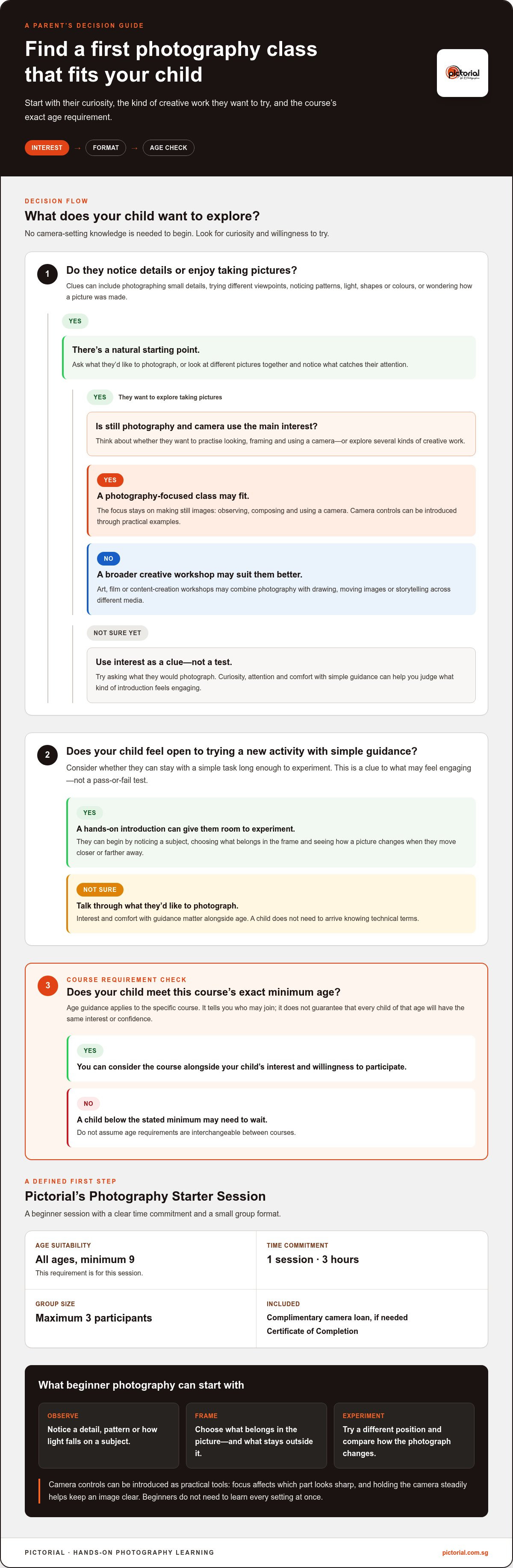
Parent’s Checklist for Kids’ Photography Classes
A few practical checks can make it easier to choose a first session without turning the decision into a big commitment. Read the course details, then weigh them against your child’s interest and comfort. The age requirement matters, as does whether the lesson sounds like something your child wants to try.
What should parents check before enrolling?
Use this checklist to compare photography classes for kids and make sure the course fits both the learner and your family’s plans.
- Minimum age: Read the exact age requirement for the specific course. Don’t assume that a general age range or another course’s requirement applies.
- Your child’s interest: Ask whether they want to learn how photographs are made, notice details and try different ways of framing a picture. Interest in using a phone or tablet is a starting point for conversation, but it isn’t the same as wanting to learn photography.
- Lesson format: Check whether the class is group or private and consider which setting your child may find comfortable. A shared class and an individual lesson are different ways to learn.
- Equipment: Check whether the course requires a personal camera or provides access to one. Pictorial’s Photography Starter Session includes Complimentary camera loan (if needed), so owning a camera isn’t a prerequisite for that session.
- Time commitment and completion: Check the number of sessions and the duration of each one, then see how they fit your family’s schedule. The Photography Starter Session is suitable for all ages, min. 9; it is 1 session, 3 hours, and includes a Certificate of Completion.
How can families make the first class feel comfortable?
Explain the plan in simple terms: your child will look closely at subjects, practise making pictures and learn about the camera through activities. Keep the description calm and specific. Knowing what to expect can help a new experience feel more familiar.
It can also help to explain that beginners don’t need to arrive with technical expertise. Camera controls can be learned gradually, and the first session doesn’t need to be a test of what your child already knows. Encourage them to notice what interests them and try different ways of looking at it.
Keep the focus on exploration, not perfect results. A picture that surprises your child or makes them curious about what to try next can be a useful part of learning. There’s no need to compare their photographs with anyone else’s or expect them to master every control straight away.
Before enrolling, review the exact course name, age requirement, session count and duration together. Then invite your child to share what they hope to photograph. This conversation helps you choose based on both the practical details and the learner’s own enthusiasm.
Pictorial’s Photography Starter Session: a practical first step
For a child who meets the age requirement and wants to try photography, Pictorial’s Photography Starter Session offers a defined first step. It is suitable for all ages, min. 9, and consists of 1 session, 3 hours. Families can see the time commitment clearly before deciding whether a focused introduction suits their child.
What families can expect from the Photography Starter Session
The session is a hands-on introduction to photography, rather than a commitment to a longer course. Children can explore the craft by using a camera and making photographs. It can be a starting point for a beginner who is curious about taking pictures.
Classes have a maximum of three participants. The small group size supports a shared learning setting with room for individual guidance. Families who need a camera can use Complimentary camera loan (if needed), and the course includes a Certificate of Completion. These details answer two practical questions parents often have: whether the session is a manageable first step and whether their child needs to own a camera beforehand.
The session sits within Pictorial’s photography courses. Its structure is straightforward: all ages, min. 9; 1 session, 3 hours. Use those details alongside your child’s interest and readiness to decide whether it is a suitable first experience with photography classes for kids.
Where to take the next step
Pictorial was founded in 2005 and is led by professional photographer Keith. If you’re weighing a one-session introduction against a longer learning path, the photography course overview lets you compare the available options and consider what might suit your family’s next step.
If the Photography Starter Session feels like a good fit, review its course details with your child and talk through the age requirement and session commitment together. Then use Pictorial’s registration page to take the next step. There’s no need to plan beyond the first experience: let your child try the session, then decide whether they’re keen to continue learning.
Give Their Curiosity Room to Grow
Before choosing among photography classes for kids, try a small, no-pressure activity together. Invite your child to pick an everyday object and take a few pictures from different viewpoints. Ask which image they like and why. The conversation can reveal more about their interest than asking whether they’re “good at photography,” while giving them a say in what they explore next.
Use their response as a starting point, not a test. If they want to keep experimenting, look for a learning option that fits their curiosity and gives them space to practise. If they’re unsure, let the idea rest and return to it later. You can ask what they’d like to learn so the next step feels like a choice they’re making with you. A first experience should open a door, not create pressure to commit to a new hobby.
Every photographer begins by noticing something worth looking at. A little encouragement can help your child take that first step at their own pace.
Frequently Asked Questions
What age can a child start photography classes?
The suitable starting age depends on the specific course, so read its stated minimum rather than relying on a general age range. 9. Age is one part of the decision: a child’s interest in taking pictures and comfort with trying a guided activity also matter. If they meet the requirement but feel unsure, talk about what they hope to photograph before enrolling.
Does my child need their own camera for a photography class?
No. A child doesn’t need to own a camera to join a Pictorial course. Pictorial offers Complimentary camera loan (if needed), and students can also use their own camera. If your child already has one, they can become familiar with its buttons and handling before the lesson. If not, borrowing one lets them try photography without buying equipment first.
How long is Pictorial’s Photography Starter Session?
Pictorial’s Photography Starter Session is 1 session, 3 hours. That makes it a defined introduction rather than a multi-session commitment. Parents can plan around the stated duration and help their child arrive ready to take part. A simple preparation step is to invite them to think of a subject they’d enjoy photographing, such as an object, pattern or scene they find interesting.
Can a complete beginner join a photography class?
Yes. A complete beginner can join a suitable introductory class. Children don’t need to know camera terms or settings before they start. A learner can begin by trying different viewpoints and observing how the subject changes in the frame. If a setting feels unfamiliar, it can be approached one practical step at a time. Choose a course whose stated level and age requirement suit your child.
What should I look for in a photography class for my child?
Look for a clear course description that states the age requirement, session commitment, learning format and equipment arrangements. Also consider whether your child wants to focus on photography or explore it alongside other creative activities. For photography classes for kids, a small class creates room for individual guidance. Pictorial classes have a maximum of three participants, and group and private options are available for the Photography Starter Session.
Are kids’ photography classes different from art or film workshops?
Yes. A photography class centres on making photographs and learning to use a camera, while an art or film workshop may combine image-making with other forms, such as drawing or moving images. A child who wants to understand how a still image is made may prefer a focused photography lesson. A child curious about several mediums may enjoy a broader format. Consider what they want to spend most of the session doing.
What does a child receive after completing a Pictorial course?
Students receive a Certificate of Completion after completing a Pictorial course. It records their participation, while the course gives them time to practise photography. Your child can keep a folder of pictures they’re proud of or note what they tried in each image. That gives them a personal way to look back on their work.

Disclaimer
© Pictorial | All Rights Reserved.